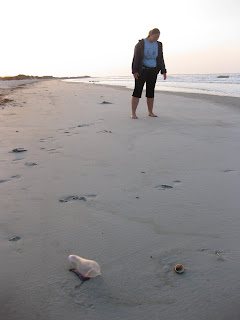
Sunday, May 1, was the first official day of monitoring for sea turtle nests on Waties Island. Beautiful morning, sunrise over the sea oats and lots of jellyfish on the beach.
 |
| A large Portuguese Man o' War siphonophore |
 |
| The tentacles on this one were about 20' long |

Some Info From Wikipedia about Man o' War:
"The Portuguese Man o' War (Physalia physalis), also known as the Portuguese man-of-war, man-of-war, or bluebottle, is a jelly-like marine invertebrate of the family Physaliidae. The name "man-of-war" is borrowed from the man-of-war, a 16th century English armed sailing ship. Despite its outward appearance, the Man o' War is not a true jellyfish but a siphonophore, which differ from jellyfish in that they are not actually a single creature, but a colonial organism made up of many minute individuals called zooids. Each of these zooids is highly-specialized and, although structurally similar to other solitary animals, are attached to each other and physiologically integrated to the extent that they are incapable of independent survival. The Man o' War is found in warm water seas floating on the surface of open ocean, its air bladder keeping it afloat and acting as a sail while the rest of the organism hangs below the surface. It has no means of self-propulsion and is entirely dependent on winds, currents, and tides. It is most common in the tropical and subtropical regions of the Pacific and Indian oceans, but can drift outside of this range on warm currents such as the Atlantic Gulf Stream."
There were lots of other animals too:
 |
| Cannonball jelly |
 |
| And a puffer fish too |

And BALLOONS! Seemed like hundreds of balloon strings and balloons this morning. A great morning for a walk on the beach.
Barb and Steve


